
Introduction
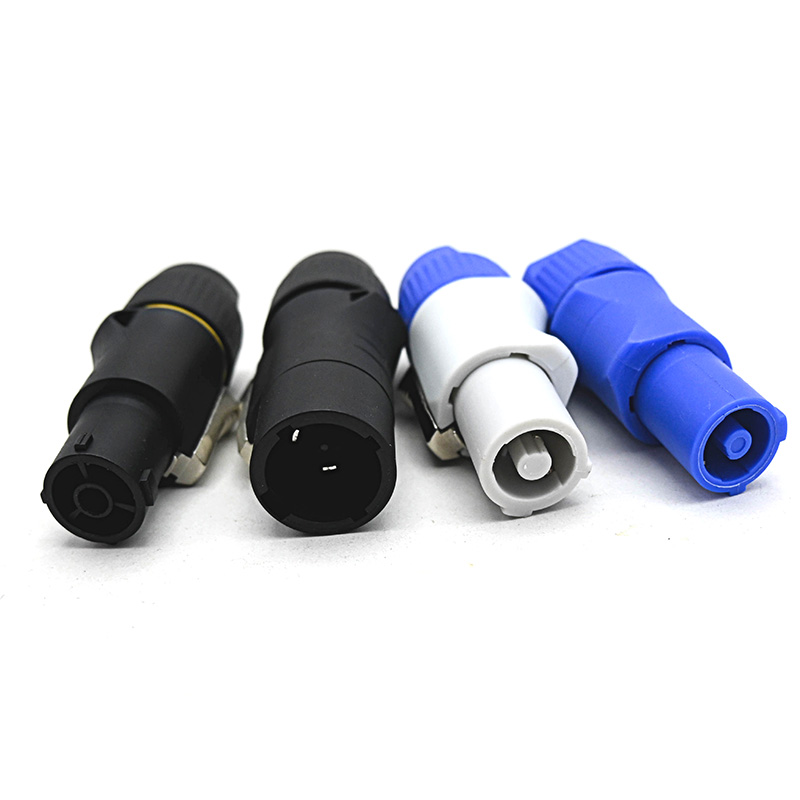
In the stage AV and lighting, Powercon and Truecon connectors have virtually completely replaced IEC C13 and C14 connectors. This is because the twist-lock connection used by Powercon and Truecon is safer, more reliable, and more convenient.
So, since both use the “twist-lock”, what exactly is the difference between Powercon and Truecon? This blog will explain the distinctions in detail.
What Are Powercon and Truecon Connectors?
Powercon and Truecon twist-lock connectors are low-voltage, 3-pole AC connectors. These connectors are widely used in stage AV and lighting equipment such as moving head lights, powered speakers, smoke machines, and mixers.
What Is a Powercon Connector?
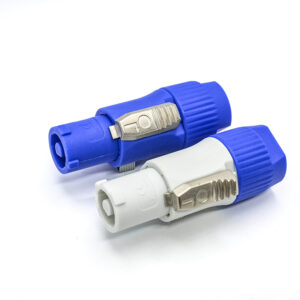
Powercon connectors typically refer to the blue NAC3FCA and white NAC3FCB connectors. However, it is important to note that Neutrik has discontinued production of these two models. They have been replaced by the NAC3FXXA and NAC3FXXB.
These comply with the IEC EN 60320 standard. They also remain compatible with older connectors. If you wish to purchase the older blue and white connectors, you can find them at Seentronic.
Powercon Connector Specifications
- Number of contacts: 2P+E
- Terminal type: Screw type (NAC3FXXA/B series requires specialized tools)
- Housing material: Reinforced composite
- Suitable wire diameter: 8 mm–12 mm (Neutrik L-type supports up to 16 mm)
- Compatible cable sizes: 3 × 1.5 mm², 3 × 2.5 mm²
- AWG sizes: 12/3, 14/3, 16/3 gauge
- Rated current: 16 A, 20 A
- Rated voltage: 250 V AC (EU); 125 V (USA, CA)
- IP rating: IP20 (indoor)
Basically, any standard household PVC or rubber AC cable can be installed in these connectors.
What Is a Truecon Connector?
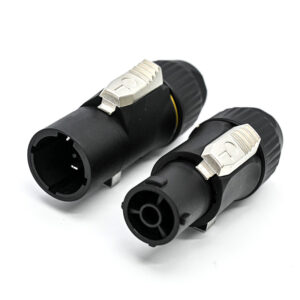
Truecon connectors generally refer to the black Powercon True1 male and female connectors. Neutrik is now encouraging equipment manufacturers to use this connector as a replacement for older Powercon models.
This connector has breaking capacity (CBC) and IP65 water resistance. It provides a rugged connection for harsh outdoor environments.
Truecon Connector Specifications
- Number of contacts: 2P+E
- Terminal type: Screw type (requires specialized tools)
- Housing material: Reinforced composite
- Suitable wire diameter: 7 mm–11 mm (Neutrik L-type supports up to 16 mm)
- Suitable cable sizes: 3 × 1.5 mm², 3 × 2.5 mm²
- AWG sizes: 12/3, 14/3, 16/3 gauge
- Rated current: 16 A, 20 A
- Rated voltage: 250 V AC (EU); 125 V (USA, CA)
- IP rating: IP65 (outdoor)
If you’re looking for the IP67 series, consider Seetronic’s X Series IP67 models.
Similarly, you can install most standard household PVC or rubber AC cables on these connectors.
Can Powercon and Truecon Cables Be Used Interchangeably?
You cannot use Powercon cables as substitutes for Truecon cables. Clearly, the two connectors are different.
Powercon vs. Truecon: What Are the Main Differences?
The main differences between Powercon and Truecon connectors are their connection types, IP ratings, breaking capacity, and options.
| Feature | Powercon | Truecon |
|---|---|---|
| Connector Type | Input and output types | Male and female types |
| IP Rating | IP20 | IP65 |
| Breaking Capacity (CBC) | No | Yes |
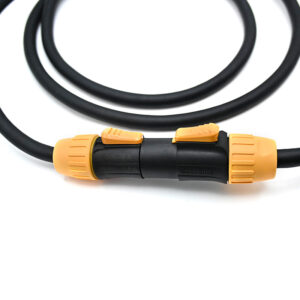
| Daisy-Chaining | Cables cannot be daisy-chained together | Cables can be daisy-chained together |
Which One Should You Choose for Your Stage Equipment?
Obviously, if your budget allows, choose equipment and cables equipped with Truecon. Currently, lighting and audio equipment manufacturers are gradually replacing Powercon chassis with Truecon chassis.
Powercon True1 is clearly more suitable, especially when you’re outdoors and may face challenges from rain. For indoor lighting and audio equipment, Powercon is also acceptable. It is more cost-effective and does the job well.
What Should You Check Before Buying a Powercon or Truecon Cable?
1. Connector Types
Before purchasing, you need to determine the type of connectors required at both ends of the cable.
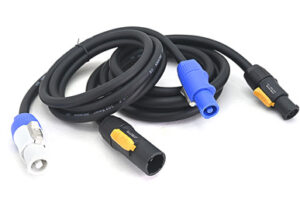
Typically, for lighting equipment, you need a Powercon blue to Powercon white cable. Or Truecon Male to Female one.
However, it’s important to note that for LED video wall connections, people usually use a Powercon blue cable.
In countries in the Americas, like Mexico and Brazil, they use an IP65-rated Powercon, not Truecon. Manufacturers make Powercon cables with injection molding. This gives the cables excellent water resistance.
2. Cable Size
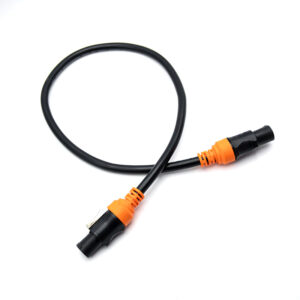
Second, you need to pay attention to the cable size: 3 × 1.5, 3 × 2.5, and 3 × 4 (12/3 AWG). These are the three standard sizes. They match 16 A, 20 A, and 20 A ratings. Each is under UL/CSA 125 V.
For a 3,000 W device, a 3 × 1.5 cable is usually sufficient.
3. Cable Flexibility and Abrasion Resistance
Finally, you should pay attention to the cable’s flexibility and abrasion resistance.
Packing up cables after a performance is a very tedious task, especially with very stiff cables. Therefore, try to purchase highly flexible cables whenever possible.
Recommended models:
- PVC cables: H05VV5-F (can be substituted with TRVV in China).
- Rubber cables: H05RR-F, H05RN-F (can be substituted with YZ or YZW in China).

Rubber cables are slightly stiffer and heavier than PVC cables. But they resist abrasion better and last longer. This makes them good for long-term outdoor shows and live broadcasts.
Looking for Powercon or Truecon Cables?
Tourycable is a professional manufacturer and exporter of stage cables. Our product range includes Powercon, Truecon, Speakon, Socapex, BNC, and XLR cables.
We can customize cable lengths, heat-shrink tubing logos, and connector brands. If you have any requests, please feel free to contact us.