
1. Introduction
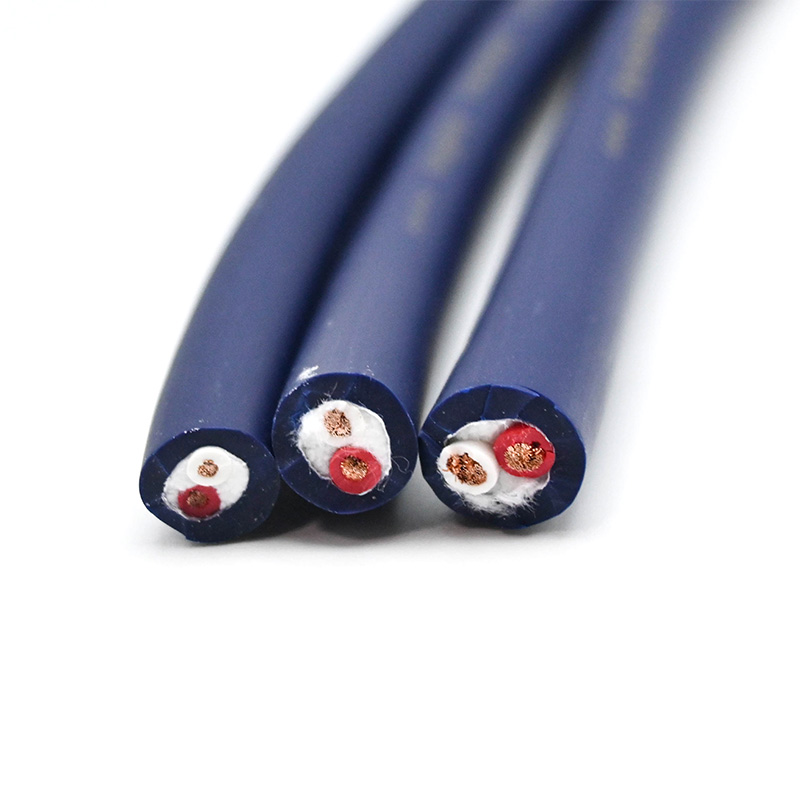
Many people ask: What kind of cable should be used for speakers?
In fact, this depends on your speaker power, the distance of the wiring, and the application.
This blog will systematically introduce the types of speaker cables and how to choose them.
2. What Is a Speaker Cable?
Speaker cable wire connects speakers to amplifiers.
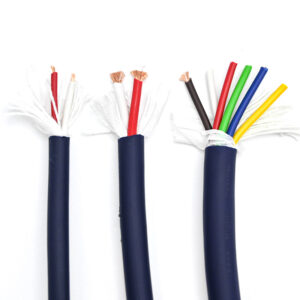
Typically, this cable features the following structure:
Conductor:
Bare copper or Tinned copper ( OFC NOT Copper Clad Aluminum)
Number of conductors:
2-core, 4-core, 6-core, or 8-core (Twisted or Parallel)
Twisted Type Cable will reduce the EMC interference surrounding
Cable Size:
1.5mm², 2mm² (14 AWG), 2.5mm², 3.3mm² (12 AWG), 4mm²
Cable Sheath Material:
Flexible PVC, Rubber, PUR, LSZH, FEP
Connector:
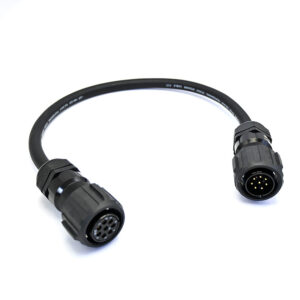
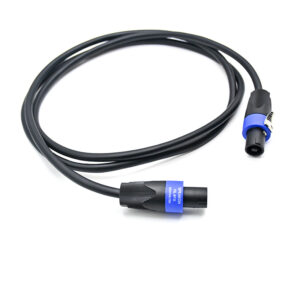
Speakon, XLR, TS, 8-Pin SPK Connector
3. Recommendations for Speaker Cable Size Length
We select speaker cable size length primarily based on two factors:
current capacity and damping factor.
3.1 Current Capacity
Using the formula:
P = I² × R
Substituting this formula into the speaker impedance power rating yields a current value.
Speaker Cable Current Data Sheet
| Cross Section mm2 |
Single Phase Current Amp |
| 1.5 | 16 |
| 2.5 | 25 |
| 4 | 32 |
Watt Amp Volt Data @ 2, 4, 8 ohm
| Watt | 2 ohm Amp | 2 ohm Volt | 4 ohm Amp | 4 ohm Volt | 8 ohm Amp | 8 ohm Volt |
|---|---|---|---|---|---|---|
| 100 | 7.1 | 14.1 | 5 | 20 | 3.5 | 28.3 |
| 200 | 10 | 20 | 7.1 | 28.3 | 5 | 40 |
| 400 | 14.1 | 28.3 | 10 | 40 | 7.1 | 56.6 |
| 500 | 15.8 | 31.6 | 11.2 | 44.7 | 7.9 | 63.2 |
| 800 | 20 | 40 | 14.1 | 56.6 | 10 | 80 |
| 1000 | 22.4 | 44.7 | 15.8 | 63.2 | 11.2 | 89.4 |
| 1200 | 24.5 | 49 | 17.3 | 69.3 | 12.2 | 98 |
| 1400 | 26.5 | 52.9 | 18.7 | 74.8 | 13.2 | 105.8 |
| 1800 | 30 | 60 | 21.2 | 84.9 | 15 | 120 |
| 2000 | 31.6 | 63.2 | 22.4 | 89.4 | 15.8 | 126.5 |
| 2400 | 34.6 | 69.3 | 24.5 | 98 | 17.3 | 138.6 |
| 3000 | 38.7 | 77.5 | 27.4 | 109.5 | 19.4 | 154.9 |
| 4000 | 44.7 | 89.4 | 31.6 | 126.5 | 22.4 | 178.9 |
Example
What gauge wire is needed for a 4Ω 2400W speaker?
2400 = I² × 4, where I = 24.5A.
As seen, 2.5mm² cable is just barely sufficient.
However, if 2.5mm² speaker wire is paired with an amplifier having 0.015Ω internal impedance, in an 8Ω speaker system, the damping factor drops to 20 after exceeding 25m; for a 4Ω speaker system, the damping factor falls to 20 after exceeding 12m.
Damping Factor
A reduced damping factor weakens control over the drivers, resulting in muddy, sluggish sound with noticeable delay.
Therefore, when selecting speaker cable, you must consider both your amplifier and speaker installation.
Position the amplifier as close to the speakers as possible and keep the cable length as short as feasible.
Damping Factor @ Different AWG, Length (m) Data Sheet
Amplifer’s Internal Resistance @ 0.04 ohm
| Speaker System’s Damping Factor @ 4ohm |
Speaker System’s Damping Factor @ 8ohm |
|||||||||
| Length\AWG | 1.5mm2 | 2mm2 | 2.5mm2 | 3.3mm2 | 4mm2 | 1.5mm2 | 2mm2 | 2.5mm2 | 3.3mm2 | 4mm2 |
| 1m | 61 | 70 | 73 | 79 | 82 | 123 | 140 | 145 | 157 | 165 |
| 2m | 44 | 54 | 57 | 65 | 70 | 88 | 107 | 114 | 130 | 140 |
| 4m | 28 | 37 | 40 | 48 | 54 | 57 | 73 | 80 | 96 | 107 |
| 8m | 17 | 22 | 25 | 32 | 37 | 33 | 45 | 50 | 63 | 73 |
| 16m | 9 | 13 | 14 | 19 | 22 | 18 | 25 | 29 | 37 | 45 |
| 20m | 7 | 10 | 12 | 16 | 19 | 15 | 21 | 24 | 31 | 38 |
| 25m | 6 | 8 | 10 | 13 | 16 | 12 | 17 | 19 | 26 | 31 |
| 30m | 5 | 7 | 8 | 11 | 13 | 10 | 14 | 16 | 22 | 27 |
Amplifer’s Internal Resistance @ 0.016 ohm
| Speaker System’s Damping Factor @ 4ohm |
Speaker System’s Damping Factor @ 8ohm |
|||||||||
| Length\AWG | 1.5mm2 | 2mm2 | 2.5mm2 | 3.3mm2 | 4mm2 | 1.5mm2 | 2mm2 | 2.5mm2 | 3.3mm2 | 4mm2 |
| 1m | 97 | 120 | 129 | 149 | 162 | 194 | 241 | 258 | 298 | 325 |
| 2m | 60 | 79 | 87 | 106 | 120 | 120 | 158 | 174 | 212 | 241 |
| 4m | 34 | 47 | 53 | 67 | 49 | 68 | 94 | 105 | 135 | 158 |
| 8m | 18 | 26 | 29 | 39 | 47 | 37 | 52 | 59 | 78 | 94 |
| 16m | 10 | 14 | 16 | 21 | 26 | 19 | 27 | 31 | 42 | 52 |
| 20m | 8 | 11 | 13 | 17 | 21 | 15 | 22 | 25 | 34 | 42 |
| 25m | 6 | 9 | 10 | 14 | 17 | 12 | 18 | 20 | 28 | 35 |
| 30m | 5 | 8 | 9 | 12 | 15 | 10 | 15 | 17 | 23 | 29 |
Notes
Copper-Clad Aluminum (CCA) Speaker Wire Note:
Copper-clad aluminum has 50% higher resistance than pure copper; usable length is reduced by 30%. Use pure copper cable whenever possible.
Connector Note:
When using performance-grade speakon connectors or 8-pin SPK speaker connectors, select round cables. This reduces strain on single conductors and extends service life.
6. Common Cable Types and Their Applications
| No. of Cores | Cross Section (mm²) | Application |
|---|---|---|
| 2 | 1.5 | Compact speakers,
5.1/7.1 home theater surround speakers |
| 2 | 2.5 | 5.1/7.1 home theater main speakers,
engineering performance main speakers, line array speakers |
| 2 | 4 | Concert theater and theater engineering wiring,
high-power main speakers, subwoofers |
| 4 | 2.5 | Special performance line array series-connected crossover speakers |
| 8 | 4 | high-power performance line array series-connected crossover speakers,
demanding high sound quality |
7. Conclusion
If you’re seeking top-tier speaker cables, consider consulting CANARE, SREXACT, or Belden—their quality is consistently reliable.
Of course, if you’re looking for suitable alternatives or have custom requirements, feel free to reach out to Tourycable. As a professional supplier of stage audio, lighting, signal, and power cables, we’re confident in delivering products that meet your expectations.